_edited.png)

Advanced Telecommunications Manufacturing
Vision-Guided Quad-Robot Soldering & Assembly Cell Case Study
The Brief
A leading manufacturer of advanced signal processing components faced critical efficiency and accuracy challenges with their highly manual, high-eye-strain assembly and soldering processes. The outdated manual method, which demanded operators to meticulously orient micro-coils and solder them by hand, resulted in production bottlenecks and variable quality. In pursuit of operational efficiency to take their business to the next level, the company collaborated with SEYMOUR Advanced Technologies to develop a fully automated, vision-guided assembly and thermal reflow cell, aiming to significantly improve component assembly precision, eliminate human error, and boost overall operational efficiency.
“We can’t solve our problems with the same thinking that we used
when we created them.”
- A. Einstein
The Challenge
Pre-Upgrade Operational Bottlenecks
The client's original manual assembly process required highly skilled operators to work in a high-eye-strain environment, meticulously picking micro-coils, orienting complex wire leads, and performing delicate soldering. This labor-intensive method led to frequent operational bottlenecks, inconsistent solder joints, and the risk of Foreign Object Debris (FOD), directly impacting production uptime and their ability to meet tight delivery deadlines.
Engineering and Operational Challenges
The design and implementation of the new precision assembly and reflow inspection system faced multiple challenges:
Complex Component Orientation: The primary engineering challenge was designing a mechanism capable of manipulating delicate micro-coils and wire leads with micron-level precision without damaging them. This required advanced 2D vision sensors to dynamically identify part orientation from bulk pallets and robotic systems to perfectly align wire loops prior to insertion.
Solder Paste Application & Reflow: Another significant challenge was applying exact, repeatable volumes of solder paste to micro-joints and establishing a highly controlled thermal reflow process. Engineering a solution involved developing a custom dispensing module and closed-loop thermal profiles to guarantee joint integrity and strict industry compliance.
3D Topographical Inspection: The system needed to guarantee zero defects on the soldered joints without human intervention. This demanded a 360-degree, 3D laser profiling system capable of measuring solder volume, identifying FOD, and verifying wire alignment before sorting.
Synchronized Quad-Robot Architecture: Ensuring precise coordination between four 6-axis robotic arms operating within a shared, compact footprint required the development of sophisticated collision avoidance and handshake algorithms within the PLC to maximize cycle time without crashes.
Our Solution
System Overview
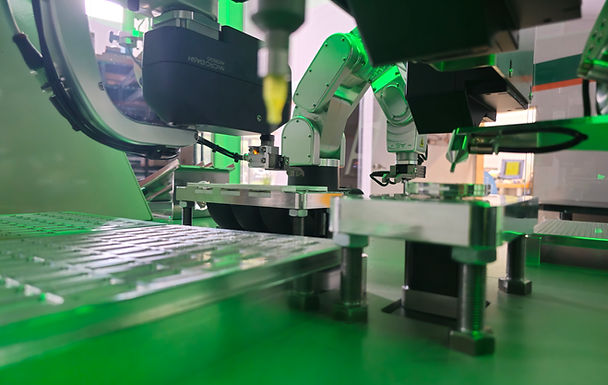
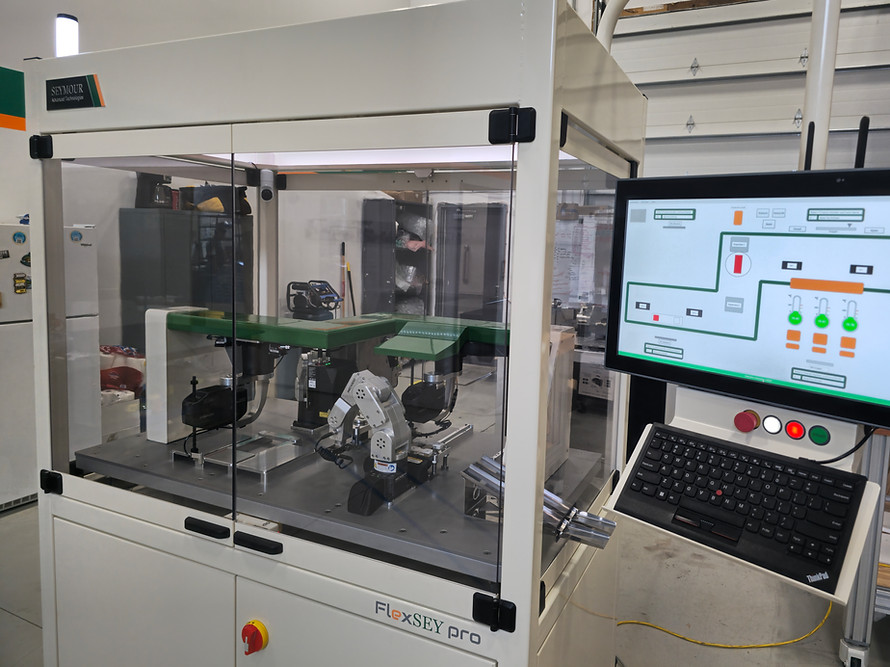
The quad-robot soldering cell designed for this advanced signal component manufacturer addresses critical challenges in handling very small parts with high precision. It was developed to significantly improve uptime and efficiency in the production process, replacing an older manual workflow that failed to meet operational expectations.
Technical Specifications
Dimensions: Compact footprint designed for easy integration into existing production floors. The machine features an enclosed, multi-station rotary architecture that maximizes throughput within a highly efficient spatial envelope.
Automated Assembly and Soldering: Engineered to execute dynamic pick-and-place operations from bulk trays, utilizing real-time offset adjustments to ensure perfectly aligned wire leads. Following assembly, an automated auger dispenses precise solder paste before the part enters a multi-stage thermal reflow station.
Quality Assurance & Part Handling: The system incorporates a final stage 3D laser inspection, reflecting a zero-defect approach to manufacturing needs. It evaluates every solder joint against strict tolerances, automatically sorting finished assemblies into dedicated "Pass" or "Fail" chutes.
Advanced Sensing and Vision Systems
Types and Models: Utilizes high-resolution 2D vision sensors to map pallet matrices and a state-of-the-art 3D laser profiler to scan completed assemblies. This differs from their previous manual inspections, which were subjective and prone to human fatigue.

Integration and Performance: These systems are integrated to work cohesively with the machine's mechanical components.
Adaptive Control Software
Control Architecture: Incorporates a robust PLC platform that dynamically adjusts operations, manages complex robot handshakes, and provides deep system diagnostics and Overall Equipment Effectiveness (OEE) data via a 21-inch touchscreen HMI.
Unique Algorithms: The system uses proprietary algorithms designed to handle the variability in part sizes and shapes, ensuring consistent quality and precision across different manufacturing runs.
Modular Design and Scalability
Modular Components: Designed for easy maintenance and quick reconfiguration, facilitating scalability and flexibility in meeting production demands.
Scalability: The system's modular nature allows for easy expansion and adaptation to new manufacturing challenges and product lines.
User Interface and System Integration
User Interface: Features a user-friendly interface that simplifies operation, allowing for seamless integration into existing production lines and facilitating communication with other manufacturing processes.
Robotic Manipulation and Precision Handling
Robotic Components: Features advanced robotic arms from Mecademic Robotics with high degrees of freedom and force sensitivity, custom-engineered for the precise manipulation of small parts.
Custom Solutions: The development included proprietary robotic solutions tailored to the specific needs of high-frequency signal component manufacturing, ensuring delicate handling without compromising part integrity


Mecademic’s Meca500 Industrial Robot
Minimizing Footprint: The Meca500 is smaller than any industrial robot arm. Featuring an embedded controller, it is also unbelievably compact.
Facilitated Integration: The Meca500 is a plug‑and‑work automation component, easy to interface with any computer or PLC. Easily operate the robot using any programming language you prefer.
Reduced Tolerances: Built with precision-machined aluminum and zero-backlash gearboxes, the Meca500 is the world’s most precise six-axis robot. It boasts a repeatability of 5 μm.
Flexibility Benefits: The robot is easy to mount in any orientation. It automatically compensates for gravity, without requiring any software adjustments. This added flexibility enables easy integration in a wide variety of settings.
Integration and Performance: These systems are integrated to work cohesively with the machine's mechanical components.
Thermal Management and Fume Extraction
Design Choices: The system is equipped with an integrated fume extraction unit and closed-loop heater controls to maintain a safe, clean, and highly regulated thermal environment for optimal solder reflow.
Compliance and Certification
Regulations and Standards: Engineered to meet stringent industry-specific regulations and standards, with built-in compliance features ensuring the system adheres to necessary certifications.
Expected Outcomes and Benefits
Productivity and Efficiency: The system is expected to eliminate manual soldering bottlenecks, drastically reduce defect rates, and reallocate skilled technical labor to higher-value tasks, significantly boosting overall manufacturing efficiency.
Transformation to New Operation Workflow
Before the New System
Operators were subjected to high-eye-strain environments, manually picking tiny coils, placing them into housings, and soldering them under microscopes. This labor-intensive process was prone to fatigue-driven errors, contributing to significant variability and inefficiency.
After Implementation
The introduction of the precision soldering cell revolutionized the operator workflow in several key ways:
-
Simplified Initial Setup: Operators now simply load raw component pallets and select the desired recipe via the central HMI, significantly reducing setup time.
-
Flexible Material Handling: Vision-guided robotics locate and adapt to part variations dynamically from bulk trays, eliminating the need for meticulous pre-sorting.
-
Autonomous Operation and Monitoring: Once components are loaded, the system autonomously manages assembly, soldering, thermal reflow, and 3D inspection. Real-time OEE dashboards allow operators to supervise rather than manually intervene.
-
Maintenance and Scalability: The modular design simplifies maintenance, and system updates or expansions can be easily managed, ensuring the automated cell evolves with the company's needs.
This workflow transformation has not only optimized efficiency and reduced the potential for human error but also empowered operators to focus on more critical aspects of the manufacturing process, enhancing overall productivity.
In Summary
The implementation of this quad-robot soldering cell for advanced signal components marked a significant leap forward. By addressing the pre-existing manual inefficiencies and introducing a highly orchestrated, vision-guided automated solution, the client was able to dramatically improve production throughput, consistency, and product quality. This case study exemplifies how SEYMOUR Advanced Technologies' FlexSEY modular automation cells can transform complex micro-assembly processes.
Contact Team SEYMOUR
Experience today the SAT difference – where cutting-edge technology meets unparalleled project management expertise and the speed and flexibility of in-house vertical integration, supported by a team of dedicated professionals at every stage.